
 Available in US
Loading...
All 48 Teams at the 2026 World Cup — Profiles, Odds and Predictions
Forty-eight nations. Four debutants. A format that has never been tested at a senior World Cup. The 2026 tournament in the United States, Mexico, and Canada expands the field by 50% compared to Qatar 2022, and the ripple effects touch every betting market — from outright winner prices to group qualification odds that shift when Curaçao draws into a pool with Germany.
I have spent the past nine months profiling every squad that punched its ticket to this tournament, and the picture that emerges is a landscape of extremes. At the top, Argentina, France, and England command the shortest outright odds, backed by squads dripping with Champions League talent and recent tournament pedigree. At the bottom, Jordan, Curaçao, Cape Verde, and Uzbekistan arrive at their first World Cup with nothing to lose and everything to prove. The middle is where things get interesting — and where most of the betting value sits.
This page profiles each tier of the tournament, highlights the key players who will define the competition, and maps out the group-by-group landscape from a betting perspective. Decimal odds throughout, Canadian context where it matters.
48 teams by group
| Group | Team 1 | Team 2 | Team 3 | Team 4 |
|---|---|---|---|---|
| A | Mexico | South Korea | South Africa | Czechia |
| B | Canada | Switzerland | Qatar | Bosnia and Herzegovina |
| C | Brazil | Morocco | Scotland | Haiti |
| D | USA | Paraguay | Australia | Turkey |
| E | Germany | Ivory Coast | Ecuador | Curaçao |
| F | Netherlands | Japan | Sweden | Tunisia |
| G | Belgium | Egypt | Iran | New Zealand |
| H | Spain | Cape Verde | Saudi Arabia | Uruguay |
| I | France | Senegal | Norway | Iraq |
| J | Argentina | Algeria | Austria | Jordan |
| K | Portugal | DR Congo | Uzbekistan | Colombia |
| L | England | Croatia | Ghana | Panama |
Title Contenders — The Six Nations With Shortest Odds
Every World Cup starts with a small club of nations the market considers realistic winners. In 2026, six teams sit below 10.00 on the outright market, and three of them have won the tournament within the last 12 years. But shortest odds do not always mean best bets — public money inflates the prices on household names, and history shows that favourites fail to convert at least as often as they succeed.
Argentina
The defending champions carry the weight of history into Group J. No nation has won three consecutive World Cups — Brazil came closest with victories in 1958 and 1962 before falling short in 1966. Lionel Scaloni’s squad retains the tactical identity that dismantled France in the 2022 final, but the Messi question looms over every projection. At 38, his role has shifted from tireless creator to selective impact player, and the transition to a post-Messi attacking structure will define Argentina’s ceiling. The supporting cast — Julian Alvarez, Enzo Fernández, Alexis Mac Allister — has aged into its prime, and the midfield depth is arguably better now than it was in Qatar. Group J (Algeria, Austria, Jordan) presents no serious obstacle to qualification, which means Argentina can rotate and arrive fresh for the knockout rounds. The market prices them among the top three, and the squad quality justifies it — the question is whether the emotional gravity of a farewell campaign helps or hinders.
France
Two finals in a row, one title, and a squad so deep that leaving world-class players out of the 26 is an annual controversy. Kylian Mbappé enters 2026 as the tournament’s most marketable attacker and the player most likely to carry a team single-handedly through a knockout bracket. Behind him, Aurélien Tchouaméni, Eduardo Camavinga, and a wave of young talent from Ligue 1 and beyond give France midfield options that no other nation can match in both volume and quality. Group I (Senegal, Norway, Iraq) is comfortable but not free — Senegal’s physical intensity and Norway’s Erling Haaland present genuine threats in individual matches. The coaching situation may shift before the tournament, but the French federation’s history of stability through transitions suggests continuity in tactical approach regardless of who sits in the dugout.
England
The Three Lions have reached the semi-finals or better in three of the last four major tournaments. The talent pool is extraordinary — an embarrassment of riches in midfield and attack, with Jude Bellingham, Bukayo Saka, Phil Foden, and Cole Palmer all entering peak years. The perennial criticism is that England’s tournament performances never quite match the sum of their individual parts, and there is historical weight behind that scepticism. Group L pairs them with Croatia, Ghana, and Panama — a draw that looks manageable on paper but contains traps. Croatia have historically performed above their ranking in knockout settings, and Ghana’s pace on the counter can punish the kind of defensive lapses England have shown under pressure. The market prices England as a top-three contender, and the squad depth supports it. Whether the mentality matches the talent is the bet you are really making.
Brazil
Five World Cup titles, zero since 2002 — a drought that has become an identity crisis. Brazil’s qualifying campaign through CONMEBOL was more turbulent than any recent cycle, with coaching changes, inconsistent results, and a generational transition that left the squad’s tactical identity in flux. The talent remains exceptional: Vinicius Junior, Rodrygo, Endrick, and a creative midfield anchored by Bruno Guimarães. But talent alone has not been enough for Brazil at recent World Cups, and the lack of a settled defensive structure is a genuine concern. Group C with Morocco, Scotland, and Haiti should be navigable, though Morocco — semi-finalists in 2022 — will not be intimidated. The market still respects the name, pricing Brazil among the top six, but the value case requires believing the new coaching regime has solved problems that have persisted since the Tite era.
Spain
Euro 2024 champions with the youngest average squad age among the favourites. Lamine Yamal will be 18 at tournament time and already plays like a veteran. Pedri, Gavi, and Nico Williams form a midfield-to-attack pipeline that blends technical precision with genuine pace — a combination previous Spanish teams lacked. The tiki-taka identity has evolved into something more direct and vertical, and the results speak for themselves. Group H includes Uruguay, a team capable of making life miserable for anyone, plus Cape Verde and Saudi Arabia. Spain’s group-stage floor is high, but the ceiling depends on whether their defensive line — the one area where depth thins — can hold against elite opposition in the later rounds. At their current price, Spain may offer the best value among the top six.
Germany
Two consecutive group-stage exits at the 2018 and 2022 World Cups would have buried most nations’ confidence. Germany’s response has been a generational reset, accelerated by hosting Euro 2024 and the psychological boost that came with a strong home tournament. Florian Wirtz and Jamal Musiala — two of the most gifted young attackers in world football — give Germany a creative axis that can unlock any defence. The midfield balance around them has improved, and the return to a pragmatic defensive structure addresses the vulnerabilities that cost them in Qatar. Group E (Ivory Coast, Ecuador, Curaçao) is one of the more straightforward draws among the favourites. Germany’s price reflects the risk of recent history repeating — but if you believe the reset is real, the odds offer more upside than Argentina or France at shorter prices.
The Three Hosts — Canada, USA and Mexico
Hosting a World Cup transforms a national team’s tournament profile in ways the market consistently underestimates. Across the last six World Cups, host nations have reached the knockout rounds five times. The combination of home crowd support, no travel fatigue, familiar climate, and the psychological lift of playing on your own pitch is a tangible advantage that shows up in results.
Canada
This is the story of the tournament for Canadian bettors. The national team qualified automatically as co-hosts, but this is no charity case — Canada earned a spot at the 2022 World Cup in Qatar on merit (their first since 1986), and the squad has only improved since. Alphonso Davies at Real Madrid is a world-class left back who functions as a second winger in transition. Jonathan David’s goal-scoring record at club level translates naturally to international football. Cyle Larin provides aerial threat and tournament experience. Jesse Marsch’s high-pressing system is built for the kind of intense, emotionally charged matches that a home World Cup produces.
Group B — Switzerland, Qatar, and Bosnia and Herzegovina — is favourable without being a walkover. Switzerland reached the quarter-finals at Euro 2024, and their tactical discipline makes them the toughest opponent Canada will face in the group stage. Qatar, the 2022 hosts, failed to win a single match at their own tournament and arrive in 2026 with a thin squad and limited competitive experience outside Asia. Bosnia stunned Italy in qualifying playoff penalties, riding a wave of momentum that could make them dangerous in their opener but difficult to sustain across three group matches. I expect Canada to top Group B, with the full Canada preview breaking down every angle in detail.
USA
The United States hosts 78 of the tournament’s 104 matches, including both semi-finals and the final at MetLife Stadium. The USMNT’s golden generation — Christian Pulisic, Weston McKennie, Tyler Adams, Gio Reyna — enters the tournament in peak years, and the squad depth has benefited from a wave of young American players earning minutes at top European clubs. Group D (Paraguay, Australia, Turkey) is navigable, though Turkey’s defensive organization and Australia’s set-piece threat pose specific challenges. The market prices USA as a dark horse to reach the semi-finals, and the home advantage across 11 venues gives that projection some structural backing. From a Canadian bettor’s perspective, the cross-border rivalry adds spice — and the CONCACAF head-to-head record provides useful data for any potential knockout-round meeting.
Mexico
El Tri open the tournament on June 11 at the Estadio Azteca — the only stadium in history to host three World Cups. Mexico’s challenge is breaking what fans call the “fifth-match curse”: elimination in the Round of 16 at every World Cup since 1994. Group A (South Korea, South Africa, Czechia) is manageable, and the altitude advantage at the Azteca gives Mexico a genuine edge in their opening matches. The squad is in transition, with an aging core giving way to younger Liga MX and European-based players, and the betting market reflects that uncertainty — Mexico’s outright odds are longer than both Canada and the USA, a ranking that would have been unthinkable a decade ago.
Dark Horses and Danger Teams
The gap between the top six and the next tier has narrowed at every recent World Cup. Morocco reached the semi-finals in 2022 from a fourth-pot draw. Croatia finished third at the same tournament despite being written off as a fading golden generation. Japan knocked out both Germany and Spain in the group stage. The 2026 expanded format — with 32 of 48 teams advancing past the group stage — makes deep runs by second-tier nations more likely, not less.
Netherlands landed in Group F alongside Japan, Sweden, and Tunisia — four teams with genuine knockout-round quality. The Oranje have the squad depth to top the group, but Japan’s speed in transition and tactical flexibility make them the single most dangerous second-tier team in the tournament. Every major sportsbook has underpriced Japan’s ceiling since 2022, and the pattern may repeat.
Portugal bring Cristiano Ronaldo to what is almost certainly his final World Cup. The narrative writes itself, but behind the storyline sits a squad — Bernardo Silva, Bruno Fernandes, Rafael Leão, Joao Neves — that would contend regardless of whether Ronaldo starts. Group K pairs them with Colombia, DR Congo, and Uzbekistan. Colombia’s CONMEBOL qualifying pedigree and counter-attacking quality make them the live threat in the group, while Portugal’s path through the bracket could be kinder than what faces the top seeds.
Uruguay deserve attention in Group H alongside Spain. Two World Cup titles, a Copa America pedigree, and a new generation featuring Federico Valverde, Darwin Núñez, and a defensive spine that concedes grudgingly. Uruguay’s price on the “to qualify from group” market is where the smart money goes — they will not win the tournament, but they can beat anyone on a given day.
Morocco’s 2022 run was not a fluke. The squad has matured since Qatar, with Achraf Hakimi, Youssef En-Nesyri, and Sofiane Boufal all entering prime years. Drawn into Group C with Brazil, Scotland, and Haiti, Morocco’s qualification odds are shorter than you might expect — the market remembers Qatar. The question is whether they can replicate that defensive resilience away from home soil and against a Brazilian attack that will come at them with more firepower than any 2022 opponent.
Belgium’s golden generation has been “fading” for four years now, yet they keep qualifying, keep reaching knockout rounds, and keep fielding a squad that matches up well in tournament formats. Group G (Egypt, Iran, New Zealand) is among the easiest draws in the competition. Kevin De Bruyne’s fitness is the variable — when healthy, Belgium’s ceiling is a semi-final. When not, they are a Round of 16 exit. The odds reflect the uncertainty, which means there is value on both the over and the under depending on pre-tournament injury news.
Debutants and Underdogs
Four nations will walk onto a World Cup pitch for the first time in 2026. Cape Verde, Curaçao, Jordan, and Uzbekistan each qualified through pathways that would have seemed improbable a decade ago — and their presence reshapes group dynamics in ways the betting market has not fully absorbed.
Cape Verde, drawn into Group H with Spain and Uruguay, carry the longest outright odds in the tournament. But this is not a token participation. Cape Verde’s qualifying run through the African confederation included results against Nigeria and Egypt that demonstrated genuine competitive quality. Their squad blends domestic African league players with European-based professionals, and the compact defensive structure that got them here can frustrate more talented opponents in the kind of low-scoring group-stage match that produces upsets.
Curaçao face Germany in Group E — a fixture that captures the romance of the expanded World Cup. With a population under 150,000, Curaçao is the smallest nation ever to qualify. Their squad draws from the Dutch football system, with several players holding dual nationality and club experience in the Eredivisie and lower European leagues. The realistic target is a competitive showing rather than qualification, but the totals market on their matches could offer value — opponents may underestimate Curaçao’s defensive organization and ship fewer goals than the raw talent gap suggests.
Jordan and Uzbekistan bring different profiles. Jordan’s run to the Asian Cup final in 2024 signalled a programme on the rise, and their Group J draw with Argentina, Algeria, and Austria presents a genuine path to a third-place finish that could mean knockout qualification under the expanded format. Uzbekistan, in Group K alongside Portugal, Colombia, and DR Congo, face a stiffer challenge but carry the deepest squad depth among the four debutants, with players competing across Asian and Eastern European leagues.
Haiti round out the underdog tier in Group C. Their first World Cup appearance since 1974 puts them in a pool with Brazil and Morocco — a brutal draw on paper. But Haiti’s Caribbean qualifying campaign showcased a fearless attacking approach, and the North American setting means shorter travel and a time zone advantage over their group-stage opponents. The totals market is the angle here: Haiti are unlikely to advance, but they may score more goals than the market expects.
Betting Tier List — All 48 Teams Ranked
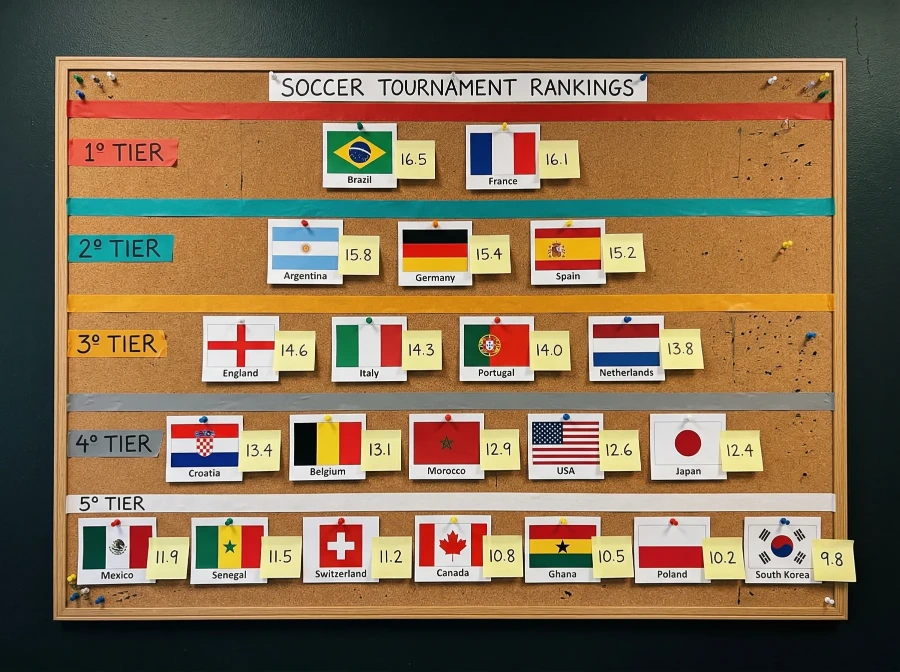
Rankings are useful only when they translate into actionable information. This tier list groups all 48 nations by their realistic tournament ceiling as priced by the current market, with my assessment of whether the odds are fair, too short (overvalued), or too long (undervalued). The tiers are not FIFA rankings — they reflect betting value.
| Tier | Ceiling | Teams |
|---|---|---|
| Tier 1 — Title contenders | Winners | Argentina, France, England, Brazil, Spain, Germany |
| Tier 2 — Semi-final capable | Semi-finals | Netherlands, Portugal, Belgium, Uruguay, Croatia |
| Tier 3 — Quarter-final ceiling | Quarter-finals | Canada, USA, Mexico, Japan, Morocco, Colombia, Senegal, Switzerland |
| Tier 4 — Knockout round threats | Round of 16 | South Korea, Turkey, Australia, Ecuador, Sweden, Norway, Austria, Algeria, Egypt, Iran, DR Congo, Ghana, Paraguay |
| Tier 5 — Group stage likely | Group stage | Tunisia, Scotland, Saudi Arabia, Czechia, South Africa, Bosnia and Herzegovina, Qatar, Iraq, Panama, New Zealand, Haiti, Jordan, Uzbekistan, Cape Verde, Curaçao |
Tier 1 is where the public money lives, and the odds are compressed accordingly. The implied probability across all six Tier 1 teams typically sums to around 55-60% of the outright market — meaning the bookmakers believe there is roughly a 40% chance the winner comes from outside this group. That 40% is where the value betting happens.
Tier 2 teams are the classic value plays. Netherlands at their current price offer more upside than Brazil despite comparable squad quality. Portugal’s path through the bracket — potentially avoiding a Tier 1 opponent until the semi-finals depending on group placement — makes their odds attractive for bettors willing to ride the Ronaldo narrative. Belgium’s price swings wildly with De Bruyne injury updates, creating in-play value opportunities before the tournament even starts.
Tier 3 is where I spend most of my pre-tournament analysis time. These are teams with genuine knockout-round quality that the market often misprices by 15-25% on “to qualify from group” lines. Canada, as hosts with a favourable Group B draw, sit at the top of this tier. Japan, after embarrassing Germany and Spain in 2022, remain underpriced in virtually every market. Morocco’s defensive structure is proven at the World Cup level, and their group odds should be shorter than they are.
Tier 4 teams are match-level plays rather than tournament-level plays. You are not backing South Korea to win the World Cup, but you might back them at value odds to beat Czechia in a Group A match, or to finish second in the group. The expanded format — where the top two from each group plus eight best third-placed teams qualify for the knockout rounds — means Tier 4 teams have legitimate paths forward, and the “to qualify” market prices often do not reflect that expanded pathway accurately.
Tier 5 is where discipline matters most. The debutants and weakest qualifiers will attract novelty bets and patriotic money from diaspora communities, but the outright and qualification odds are almost never worth taking. The play on Tier 5 teams is in specific match markets — totals, handicaps, and props where the bookmaker’s model underestimates defensive compactness or overestimates the talent gap.
Follow Your Roots — World Cup Teams With Canadian Connections
Canada’s multicultural fabric makes this World Cup personal for millions of Canadians whose families came from competing nations. Walk through any neighbourhood in the GTA, Vancouver, Montreal, or Calgary during the tournament, and you will see flags that tell a story beyond soccer — Italian tricolours in Woodbridge, Portuguese crests along Dundas West, Croatian checkerboards in Mississauga, Jamaican colours in Scarborough, and Algerian green-and-white in Laval.
Italy did not qualify — knocked out by Bosnia and Herzegovina in the playoff — which redirects that diaspora’s emotional energy in an unusual direction. Some Italian-Canadians will back Bosnia out of respect for the result, while others will adopt a second team or simply focus on betting the tournament with less emotional baggage. Either way, the absent Azzurri leave a gap in Canada’s World Cup culture that no other team will fill.
Portugal’s enormous Canadian community, concentrated in Toronto and the southern Ontario corridor, makes the Portuguese squad a de facto second home team for hundreds of thousands of fans. Cristiano Ronaldo’s likely farewell tournament adds a generational layer to the interest. Croatia, despite a smaller population base, punches above its weight in Canadian sports culture — the 2018 World Cup final run turned Croatian-Canadian neighbourhoods into open-air festivals that lasted weeks.
Algeria’s qualification fires up a passionate community in Montreal and Quebec, where the North African diaspora follows Les Fennecs with an intensity that rivals any national team support base in the country. Ghana’s presence in Group L resonates with a growing West African community across the Greater Toronto Area and Alberta. Colombia’s qualification through CONMEBOL lights up the Colombian-Canadian network from Vancouver to Halifax.
The betting implication is real: diaspora money flows heavily toward these teams in Canadian sportsbook markets, particularly on outright and group qualification bets. That emotional volume can create pricing distortions — especially on smaller platforms where the book balances around Canadian-specific bet patterns. If you can stay dispassionate about your ancestral team, the odds on the other side of the ledger sometimes offer genuine value.
20 Players Who Will Define This Tournament
A World Cup is decided by 736 players (26 per squad across 48 teams for the expanded rosters), but a handful of individuals carry the weight of their nation’s expectations — and move betting markets when they play, sit out, or arrive in uncertain fitness. These are the 20 players whose form, fitness, and performance will most directly influence how you bet the 2026 tournament.
Kylian Mbappé — France’s talisman and the most complete attacker in the tournament. His pace, finishing, and big-game mentality make France’s price justified almost single-handedly. Lionel Messi — if he is in the squad, Argentina’s approach changes; if he is not, the entire team’s dynamic shifts. The single biggest unknown in the outright market. Jude Bellingham — England’s creative conductor, capable of winning a match in a moment. His fitness after a long club season is the variable to watch. Vinicius Junior — Brazil’s most dangerous player, a Ballon d’Or contender who can turn any deficit into an equalizer. Lamine Yamal — 18 years old and already Spain’s most important attacking outlet. The youngest player among the favourites’ starting elevens.
Alphonso Davies — Canada’s most recognizable player globally, a left back whose speed and attacking runs change matches. His transition from Bayern to Real Madrid adds star power and tactical versatility. Erling Haaland — Norway’s generational striker, in Group I with France. If Norway are to cause an upset, Haaland’s goals are the mechanism. Cristiano Ronaldo — Portugal’s all-time scorer at what is almost certainly his final World Cup. The narrative drives public money; the question is whether it also drives Portugal’s tactical decisions. Florian Wirtz — Germany’s creative spark, the player most likely to make the tournament-wide breakthrough that announces a new star. Federico Valverde — Uruguay’s engine, a box-to-box midfielder who plays every match like a knockout tie.

Achraf Hakimi — Morocco’s marauding right back, essential to both defensive solidity and attacking width. Jonathan David — Canada’s leading scorer and clinical finisher, the player most likely to deliver a defining Canadian World Cup moment. Son Heung-min — South Korea’s captain and all-time top scorer, competing in what may be his last major tournament. Bukayo Saka — England’s most consistent performer in recent tournaments, a winger who delivers in high-pressure moments. Kevin De Bruyne — Belgium’s heartbeat. His availability determines whether Belgium are semi-final contenders or Round of 16 fodder.
Pedri — Spain’s midfield metronome, the player who controls tempo and makes everything around him function. Enzo Fernández — Argentina’s midfield anchor, a World Cup winner at 21 who has grown into one of the world’s best ball-progressing midfielders. Christian Pulisic — America’s most recognized soccer export and the player USA needs to fire if the hosts are to match their billing. Darwin Núñez — Uruguay’s unpredictable striker, capable of brilliance and frustration in equal measure. Kaoru Mitoma — Japan’s dribbling menace, the player who can unlock defensive blocks with individual quality that few group-stage opponents can contain.
Where the Value Sits Across 48 Squads
Nine years of covering tournament markets have taught me one consistent lesson: the public overestimates the gap between the favourites and the rest. In 2022, the pre-tournament top three in the outright market were Brazil, France, and England. Brazil exited in the quarter-finals. England lost there too. France reached the final but needed a Mbappé hat-trick and a penalty shootout to survive Argentina’s relentless pressure. The winner, Argentina, was fourth or fifth in most pre-tournament pricing.
The 2026 value map follows a familiar shape. Tier 1 teams are overpriced on the outright market relative to their actual chances because public money compresses their odds beyond fair value. The sweet spot is Tier 2 and upper Tier 3 — teams like France, Netherlands, Portugal, and Japan, whose odds offer upside that matches their realistic tournament ceiling. At the match level, the expanded 48-team format creates more mismatches in the group stage, which means more predictable outcomes on the match-result market and more reliable data points for knockout-round analysis.
For Canadian bettors, this tournament offers a rare convergence: a home World Cup, a competitive national team, a legal and regulated betting market, and tax-free winnings. Whether you are backing Argentina to defend their title, hunting for group-stage value on Japan or Morocco, or riding the emotion of Canada’s home campaign at BMO Field, the 48-team field gives you more markets, more angles, and more opportunities than any World Cup in history. The teams are set. The groups are drawn. The work starts now.
