
 Available in US
Loading...
How to Bet on the 2026 World Cup — A Complete Canadian Guide

Five years ago, placing a single-game wager in Canada meant breaking the law or driving to a tribal casino south of the border. That changed on August 27, 2021, when Bill C-218 dismantled the old parlay-only framework and handed Canadians something the rest of the betting world had taken for granted: the right to pick one match and put money on it. Now the biggest soccer tournament ever assembled is rolling into our backyard — 48 teams, 104 matches, three host nations, and two of those stadiums sitting on Canadian soil.
I have covered tournament betting markets for nine years, and no event in that span matches the scale of what is coming this summer. The expanded format means more group-stage matches, more knockout rounds, and more market inefficiencies for bettors who do their homework. Whether you opened your first sportsbook account last month or you have been grinding Proline+ parlays since before legalization, this guide — part of our broader 2026 World Cup betting hub — walks through every layer of World Cup betting — from the legal nuts and bolts in your province to the bankroll math that keeps you solvent across 39 days of football.
Everything here uses decimal odds, the standard format on Canadian platforms. All currency references are in CAD. And one detail worth highlighting right at the top: recreational gambling winnings in Canada are not taxed. That alone shifts the math in your favour compared to bettors south of the border.
Key facts before you start
| Tournament | 2026 FIFA World Cup — 48 teams, 104 matches, June 11 to July 19 |
| Host nations | United States (78 matches), Mexico (13 matches), Canada (13 matches) |
| Canadian venues | BMO Field (Toronto), BC Place (Vancouver) |
| Legal status | Single-event sports betting legal federally since August 2021 (Bill C-218) |
| Odds format | Decimal (standard across Canadian sportsbooks) |
| Currency | CAD (C$) |
| Tax on winnings | None for recreational bettors |
| Canada’s group | Group B — Canada, Switzerland, Qatar, Bosnia and Herzegovina |
The Legal Side — Sports Betting in Canada in 2026
Bill C-218 and What Changed
For decades, Canadian bettors lived inside a bizarre legal cage. The Criminal Code permitted sports wagering — but only on parlays of two or more events. Want to bet that Canada would beat Qatar straight up? Tough luck. You had to bundle it with at least one other selection. Provincial lottery corporations ran the show through products like Proline in Ontario, Mise-o-jeu in Quebec, and PlayNow in British Columbia. The experience was clunky, the odds were poor, and the margins were enormous.
Bill C-218, titled the Safe and Regulated Sports Betting Act, rewrote that chapter. It amended Section 207 of the Criminal Code, removing the parlay restriction and decriminalizing single-event betting. The bill received Royal Assent in June 2021, and regulations took effect on August 27 of that year. Overnight, provincial governments gained the authority to license, regulate, and tax single-game wagering within their borders.
The key word there is “provincial.” Canada did not create a single federal regulator. Instead, each province decides how to structure its market — who can operate, what products are allowed, and what advertising rules apply. That means the betting experience in Toronto looks meaningfully different from the one in Vancouver or Montreal. Five years into legalization, the provincial patchwork remains the defining feature of Canadian sports betting.
One federal development worth tracking: Bill S-211, the National Framework on Sports Betting Advertising Act, has passed three readings in the Senate and moved to the House of Commons. If enacted, it would establish the first nationwide advertising standards for sports wagering — a significant shift from the current province-by-province approach. For now, the Code for Responsible Gaming Advertising (CGA Code), administered by Ad Standards and in effect since January 2026, serves as the closest thing to a unified set of rules. Under the CGA Code, operators cannot publicly advertise bonuses or promotions — those offers are restricted to direct marketing with verified, opted-in players. No depicting gambling as risk-free. No suggesting it solves financial problems.
Province by Province — Ontario, Alberta and Beyond
Ontario is the outlier. It is the only province that opened its market to private operators, launching the iGaming Ontario framework in April 2022. The Alcohol and Gaming Commission of Ontario (AGCO) handles licensing and enforcement. As of early 2026, 48 operators hold active licences in Ontario — from global sportsbook brands to homegrown platforms. Ontario also introduced a ban on using current or former athletes in betting advertisements, effective since February 2024. If you live in the GTA or anywhere in the province, you have more platform choices than bettors in any other part of the country.
Alberta is next in line. The Alberta Gaming, Liquor and Cannabis Commission (AGLC) oversees the province’s gambling framework, and Bill 48 set the stage for an open private market launching in summer 2026. The timing is deliberate — the World Cup begins June 11, and Alberta wants licensed operators ready for kickoff. Until that market opens, Albertans can use the provincial PlayAlberta platform or access offshore sites that technically operate in a grey area.
The remaining provinces funnel online betting through their lottery corporations. British Columbia runs PlayNow through the British Columbia Lottery Corporation. Quebec offers Mise-o-jeu through Loto-Quebec. Manitoba, Saskatchewan, and the Atlantic provinces each have their own provincial products. The odds on these platforms tend to carry higher margins than what you find on private-market operators in Ontario, because the lottery corporations face no direct domestic competition.
| Province | Regulator | Market type | Private operators |
|---|---|---|---|
| Ontario | AGCO / iGaming Ontario | Open (private + provincial) | 48 licensed |
| Alberta | AGLC | Opening summer 2026 (Bill 48) | Pending |
| British Columbia | BCLC | Provincial monopoly | None (PlayNow only) |
| Quebec | Loto-Quebec | Provincial monopoly | None (Mise-o-jeu only) |
| Other provinces | Provincial lottery corps | Provincial monopoly | None |
The bottom line for World Cup betting: your province determines your platform options. Ontario bettors shop for the best odds across dozens of operators. Bettors elsewhere either use their provincial platform or wait for Alberta’s market to go live. Regardless of where you are, single-event wagers on every World Cup match are fully legal on any provincially authorized platform.
Reading Decimal Odds Like a Pro
Decimal vs American — A Canadian Perspective
Walk into any conversation about sports betting south of the border and you will hear numbers like -110, +250, -150. That is the American format — a system built on a base unit of 100 that tells you either how much you need to risk to win $100 (negative) or how much you win on a $100 stake (positive). It works, but it forces you to run two different mental calculations depending on whether the number is positive or negative.
Canadian sportsbooks default to decimal odds, and for good reason. The number you see is the total return multiplier. A line of 2.50 means every dollar staked returns $2.50 if the bet wins — your original dollar plus $1.50 in profit. A line of 1.40 returns $1.40 per dollar. No sign changes, no flipping the formula. One operation: stake multiplied by odds equals total payout. That simplicity matters when you are scanning 12 group-stage matches on a Tuesday afternoon and comparing lines across platforms.
Most Canadian platforms let you toggle between decimal, American, and fractional formats in your account settings. My recommendation: stick with decimal for World Cup betting. The format makes it faster to calculate implied probabilities, compare lines, and size parlays. Every odds reference in this guide uses decimal.
Calculating Your Payout
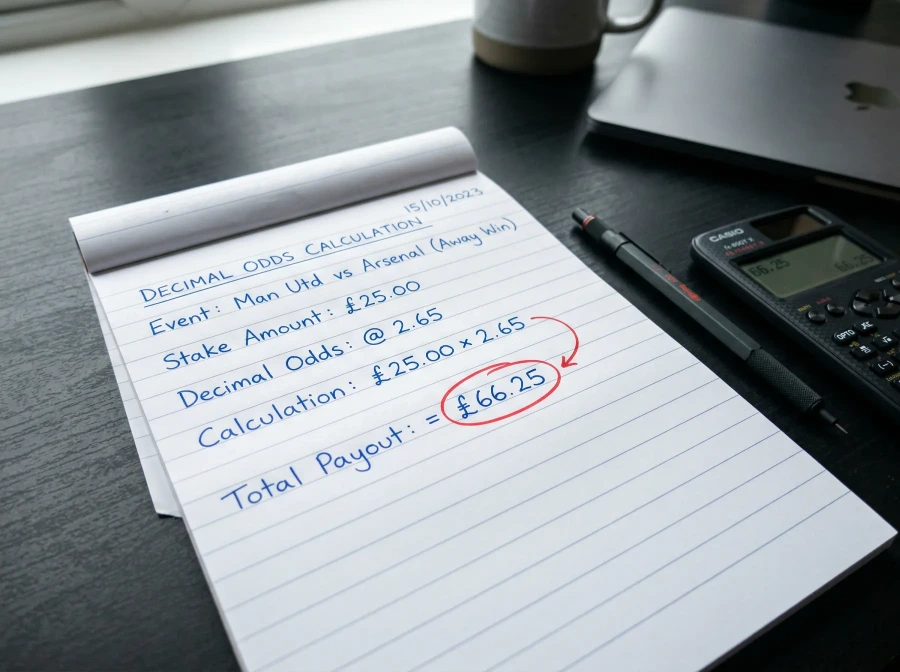
The formula is as clean as it gets. Take your stake, multiply by the decimal odds, and that is your total return — stake included. On a C$25 bet at odds of 3.40, the math is 25 multiplied by 3.40, which gives you C$85. Your profit is C$60 (total return minus the original stake).
Where this matters most is when you are comparing two lines. Say one platform offers Canada to beat Bosnia and Herzegovina at 1.72, and another has the same market at 1.78. On a C$100 bet, the first returns C$172 and the second returns C$178. That C$6 difference looks small on one wager, but compound it across 30 or 40 bets over a 39-day tournament and the gap becomes material. Line shopping — checking multiple platforms for the best price — is the single easiest edge available to Canadian bettors, especially in Ontario where the operator pool is deep enough to create genuine price competition.
Implied probability converts odds into a percentage that tells you how likely the market believes an outcome is. The formula: 1 divided by the decimal odds, then multiply by 100. At odds of 4.00, the implied probability is 25%. At 1.50, it is 66.7%. Knowing how to run this calculation quickly helps you identify when the market is overpricing or underpricing a team — and that is where value bets live.
One nuance Canadian bettors should internalize: the sum of implied probabilities across all outcomes in a market will exceed 100%. The excess is the bookmaker’s margin, sometimes called the overround or vigorish. On a typical three-way World Cup match market (home win, draw, away win), the combined implied probability might total 105% or 106%. The lower that number, the better the odds for you. Platforms in competitive markets — Ontario, primarily — tend to run tighter margins than provincial monopolies.
World Cup Betting Markets — From Moneyline to Props
Moneyline, Draw and Match Result
The three-way match result is the bread and butter of soccer betting. Pick the home team to win, the away team to win, or the draw. Unlike North American sports where ties are rare or impossible, draws happen in roughly a quarter of World Cup group-stage matches. That third outcome is the structural feature that separates soccer betting from what most Canadian sports fans are used to in hockey or basketball.
Moneyline in the strict North American sense — a two-way market that eliminates the draw — is also available, but it works differently here. If the match ends level in regular time, your moneyline bet pushes (stake returned) or is settled based on extra time and penalties depending on the platform’s rules. In the knockout rounds, where matches must produce a winner, the moneyline becomes a cleaner two-way proposition. Always check whether your platform settles on 90-minute result or includes extra time before placing a knockout-stage wager. For a deeper breakdown of each market, the World Cup bet types guide covers the mechanics in full.
Spread and Totals (Over/Under)
The spread — called the handicap in European markets — gives one team a virtual head start or deficit. Canada -0.5 against Qatar means Canada must win outright for the bet to pay. Canada -1.5 means they need to win by two or more goals. The half-goal increments eliminate the possibility of a push.
Asian handicap markets add another layer with whole-number and quarter-number lines (-0.25, -0.75, -1.25). These split your stake across two adjacent lines and can return half your bet even on a partial loss. The concept confuses newcomers, but Asian handicaps are among the sharpest markets available for World Cup matches because they attract high-volume professional betting traffic that keeps the lines efficient.
Totals — over/under on goals scored — sit at 2.5 for most World Cup group games. That is the inflection point: either the match produces three or more goals (over) or it does not (under). Historical data from the last five World Cups shows an average of 2.64 goals per group-stage match, which means the 2.5 line is finely balanced but slightly favours the over in aggregate. Totals at 1.5 and 3.5 are available at adjusted prices for bettors who want more or less risk.
Parlays — Canada’s Old Favourite
Before Bill C-218, every legal sports bet in Canada was a parlay. Proline required a minimum of two selections — originally three — and the culture of bundling picks into accumulators runs deep in the Canadian betting psyche. Parlays multiply the odds of each selection together, creating larger potential payouts from small stakes. A three-leg parlay combining Canada to beat Bosnia (1.72), Brazil to beat Haiti (1.18), and France to beat Iraq (1.25) produces combined odds of roughly 2.54 — turning a C$10 bet into a C$25.40 return.
The catch, and it is a significant one, is that every leg must win. One loss kills the entire ticket. Over a 39-day tournament with 104 matches, the temptation to build five-leg and six-leg parlays on a busy match day is enormous. The expected value of those bets is almost always negative — the bookmaker’s margin compounds with each additional leg, and the probability of sweeping all selections drops faster than most bettors intuit. I treat parlays as entertainment bets with small stakes, not as a core strategy. If you want concrete combinations to consider, the World Cup parlay picks breakdown maps out specific group-stage combos with the math attached. The real edge in World Cup betting comes from disciplined single-game wagers where you have identified a specific market inefficiency.
Prop Bets and Specials
Player props let you bet on individual performances: Kylian Mbappé to score anytime, Alphonso Davies to register an assist, a goalkeeper to keep a clean sheet. Match props cover events like the number of corners, booking points (yellow and red cards), the time of the first goal, and whether both teams score. Tournament-level props extend to outright markets: top scorer (Golden Boot), best young player, the highest-scoring group, the continent of the winning team.
Props are where sportsbooks widen their margins the most, because the markets attract less sharp money and fewer sophisticated models. But they also offer the most room for bettors with genuine subject knowledge. If you have watched Canada’s qualifying campaign closely and understand how Jesse Marsch’s pressing system generates corner kicks, you may have an edge on a corners line that a bookmaker’s algorithm set based on broader league averages. The key is selectivity — prop markets reward specialists, not generalists throwing darts at a board.
Bankroll Strategy for a 39-Day Tournament
The 2026 World Cup runs from June 11 to July 19 — 39 days, 104 matches, and an average of roughly three matches per day during the group stage. That density creates a unique bankroll challenge. Unlike a league season where you might place four or five bets per week, a World Cup can tempt you into 10 or 15 wagers on a single day. Without a plan, your bankroll evaporates before the knockout rounds begin.
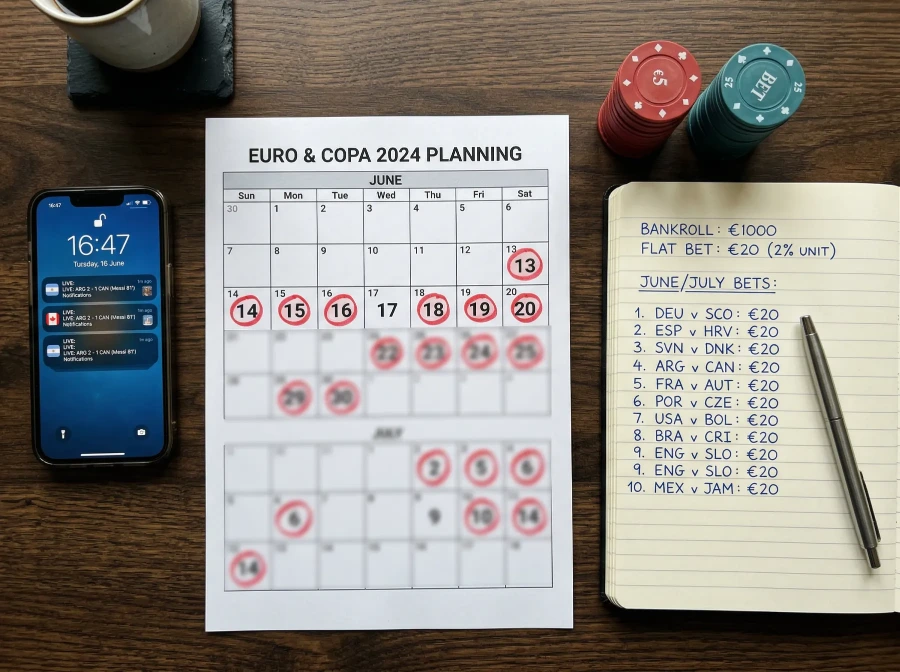
I use a flat-betting approach for tournaments. Decide your total World Cup bankroll before June 11 — the amount you can lose entirely without it affecting your life. Divide that bankroll by the number of bets you expect to place over the tournament. If your bankroll is C$1,000 and you plan roughly 60 bets across the group stage and knockouts, each unit is approximately C$16 to C$17. Every standard bet gets one unit. A strong conviction play — maybe two per round — gets 1.5 units. Nothing gets three units. Nothing.
The math behind flat betting is straightforward but powerful. By keeping each wager at a consistent percentage of your starting bankroll — typically between 1% and 3% — you ensure that a losing streak does not wipe you out before the variance evens out. A run of five losses on 2% unit bets costs you 10% of your bankroll. Painful, but survivable. That same streak on 10% unit bets costs half your bankroll, and the psychological pressure to chase losses becomes overwhelming.
Tournament betting has a structural quirk that league betting does not: information quality improves dramatically as the event progresses. In the group stage, you are betting on teams that may not have played a competitive match in months. By the Round of 16, you have seen them perform under tournament conditions, and the market lines become sharper. I deliberately reserve 30% to 40% of my bankroll for the knockout rounds, where the analytical edge from watching matches live outweighs anything you can model beforehand.
One more piece of the puzzle: take breaks. Match days with six simultaneous kickoffs create a fear of missing out that clouds judgment. Not every match needs a bet. The best tournament bettors I know place fewer wagers than casual fans assume — they just make each one count.
Spotting Value in World Cup Markets
A bet has value when the odds offered by the sportsbook imply a lower probability than your own assessment. If you believe Canada has a 65% chance of beating Qatar and the market prices Canada at 1.70 (implied probability 58.8%), the gap between your estimate and the market’s estimate represents positive expected value. Over a large enough sample, consistently finding and exploiting these gaps is what separates profitable bettors from everyone else.
World Cup markets are particularly ripe for value because the tournament format compresses a massive amount of uncertainty into a short window. Club football generates hundreds of data points per team per season. National teams play a fraction of that schedule, and the squads change between every window. Bookmakers rely heavily on FIFA rankings, historical results, and public perception — all of which lag behind real-time squad quality. That lag is your opportunity.
There are specific patterns I look for. Host nations tend to be undervalued in group-stage match markets because the market discounts home advantage inconsistently. Canada playing at BMO Field in Toronto on June 12 against Bosnia and Herzegovina carries a tangible crowd effect that generic models underweight. Conversely, traditional powerhouses — Brazil, Germany, Argentina — tend to be overvalued on the outright winner market because casual money floods in on name recognition rather than current form.
Another reliable value pocket is the “to qualify from group” market for second-tier teams. Morocco, a semi-finalist in 2022, is drawn into Group C with Brazil, Scotland, and Haiti. The market will price Morocco’s group qualification odds based partly on their 2022 run, but Qatar’s 2022 hosting experience showed that a strong home tournament does not automatically translate to the next cycle. Separating genuine improvement from tournament-specific circumstances is where the work happens.
The practical step: build a simple spreadsheet before the tournament. For each group match, estimate the probability of each outcome (home win, draw, away win) based on your research. Convert to decimal odds (1 divided by your probability). Compare your price to the market price. If the market offers odds higher than your estimate, you have a potential value bet. If the gap is large enough to absorb the bookmaker’s margin — typically 3% to 5% on match result markets — it is worth placing. Track every bet, every outcome, and review your estimates against results at the end of the group stage. The feedback loop is how you improve. I have already flagged several specific opportunities in the World Cup value bets analysis, where I break down mispriced outright and group markets heading into June.
Tax-Free Winnings — Canada’s Edge
In the United States, the Internal Revenue Service treats gambling winnings as taxable income. Win a US$5,000 futures bet on Argentina to lift the trophy, and the IRS wants its share — typically 24% withheld at the point of payout for non-resident aliens, and reported on a W-2G form for American citizens. The effective tax rate on gambling winnings in the US ranges from 10% to 37% depending on the individual’s income bracket.
Canada operates under a fundamentally different framework. The Canada Revenue Agency does not tax gambling winnings for recreational players. If you place a C$50 bet on Canada to win Group B at odds of 2.20 and it pays out C$110, every dollar of that C$60 profit is yours. No withholding, no reporting, no year-end tax form. This applies to all forms of legal gambling — sports betting, casino, poker, lottery — as long as gambling is not your primary source of income.
The distinction hinges on the word “recreational.” The CRA considers gambling winnings a windfall rather than income for individuals who bet casually. If gambling constitutes a business activity — meaning you do it systematically, with the intention of profit, as a primary occupation — the CRA may classify your winnings as business income subject to taxation. The line between recreational and professional is drawn on a case-by-case basis, but the vast majority of Canadians who bet on the World Cup fall squarely into the recreational category.
What this means in practical terms: your effective return on every winning World Cup bet is higher than the equivalent return for an American bettor placing the same wager at the same odds. Over a 39-day tournament with dozens of bets, that tax advantage compounds into a meaningful difference. It is one of the genuine structural benefits of betting from Canada, and it is worth factoring into your bankroll calculations from day one.
Seven Costly Mistakes World Cup Bettors Make
I have watched smart bettors sabotage their own World Cup campaigns in every tournament since 2014. The mistakes repeat with depressing consistency. Here are the seven that do the most damage — and the fixes that keep you out of trouble.
1. Betting every match. The group stage averages three to four matches per day. The urge to have action on every kickoff is real, and it is a bankroll killer. Quality beats quantity in tournament betting. If your research gives you a clear edge on two of the day’s four matches, bet those two and watch the others. Having no stake in a match lets you evaluate teams as a neutral observer — information that pays off when those teams appear in later rounds.
2. Ignoring the draw. Newcomers to soccer betting default to picking a winner. In group-stage matches between similarly ranked teams, the draw is frequently the highest-value outcome. The 2022 World Cup produced 10 draws in 48 group matches — roughly one in every five games. The market often underprices the draw because casual money gravitates toward decisive outcomes. Leaving the draw out of your analysis means leaving value on the table.
3. Overloading parlays. A five-leg parlay on match day one feels brilliant when you are building it and devastating when one leg fails in the 87th minute. The bookmaker’s margin compounds with each leg: on a five-leg parlay with a 5% margin per leg, the effective overround approaches 28%. You are paying a steep price for the thrill of a big payout. Limit parlays to two or three legs, and keep the stakes small.
4. Chasing losses after a bad day. Day three of the group stage, you are down C$150. The late match features a heavy favourite at 1.30 odds. You double your unit size to claw back losses quickly. The favourite draws. Now you are down C$200 and making worse decisions. Chasing losses is the fastest path to a blown bankroll. The flat-betting system exists precisely for these moments — trust the unit size, absorb the loss, and move on.
5. Betting the outright market too late. Outright winner odds compress as the tournament progresses because uncertainty decreases with each round of matches. The best value on tournament winner bets exists before the opening whistle. If you believe a team is mispriced, lock in the odds before the group stage begins. Waiting until the quarter-finals to bet a favourite gives you shorter odds and less upside.
6. Neglecting squad news. National team managers announce their final 26-player squads weeks before the tournament. Injuries, tactical decisions, and surprise inclusions reshape a team’s profile overnight. A starting goalkeeper injury can shift a team’s defensive solidity — and its match odds — by a significant margin. Follow squad announcements, track training reports, and adjust your positions before the market catches up.
7. Treating the World Cup like club football. Club teams play together 50 or 60 times a year. National teams might get 10 to 15 matches across a two-year cycle, and the squad composition changes in every window. The statistical models that work for the Premier League or MLS are less reliable for international football, where chemistry, tournament experience, and managerial cohesion matter more than raw talent aggregation. Adjust your analytical framework accordingly — weight recent tournament performances, head-to-head records, and the manager’s big-game track record over season-long club statistics.
The Smart Bettor’s Checklist for 2026
You have the legal framework. You know how decimal odds work, how to calculate payouts, and where value lives. Before you place your first World Cup wager, run through this checklist — it distills everything above into the decisions that matter most in the next 39 days.
Set your bankroll before June 11 and divide it into units. One unit per standard bet, 1.5 units maximum for high-conviction plays. Resist the urge to resize mid-tournament. Open accounts on at least two platforms if your province allows it — Ontario bettors have dozens of options, and even a 0.05 difference in decimal odds adds up over 60 bets. Compare lines on every wager, not just the ones that feel close.
Build your probability estimates independently before checking the market. If your number and the market’s number disagree by more than 5%, investigate why. Sometimes the market knows something you missed — an injury report, a tactical shift, a travel schedule complication. Sometimes the market is wrong. Your job is to tell the difference.
Reserve at least a third of your bankroll for the knockout rounds. The group stage is where you gather data. The knockouts are where you deploy it. Every match you watch without a bet is an investment in your later wagers. Keep a log of every bet: date, match, market, odds, stake, outcome. Review it after the group stage and again after the tournament ends. The bettors who improve between World Cups are the ones who track and learn from their mistakes.
Canada is hosting matches in Toronto and Vancouver. The national team plays its first home World Cup match in 40 years on June 12 at BMO Field. The atmosphere will be extraordinary. The temptation to bet with your heart instead of your head will be powerful. Enjoy the moment — but keep your World Cup odds analysis separate from your patriotic fervour. The market does not care which flag you wave. It only cares whether you are right.
