
 Available in US
Loading...
Argentina at the 2026 World Cup — Defending Champions’ Odds and Preview
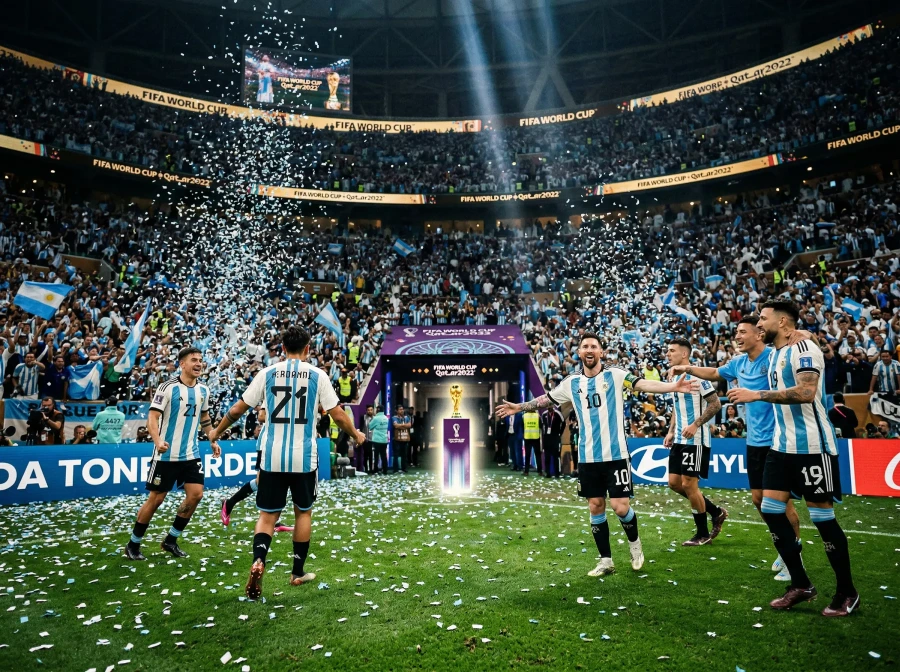
No nation has won three consecutive major international titles. Argentina — reigning World Cup and Copa America champions — are attempting exactly that, and the betting market cannot decide whether to price them as favourites or as a team on the wrong side of a generational peak. That uncertainty is where I find the most interesting angles on the defending champions heading into a tournament that could cement a dynasty or reveal a team running on fumes.
Road to 2026 — CONMEBOL Qualifying Campaign
CONMEBOL qualifying is the hardest path to a World Cup for a reason. Ten nations play each other home and away across 18 matchdays, and the altitude of La Paz, the humidity of Barranquilla, and the intensity of Montevideo break squads that look untouchable in friendlies. Argentina navigated the cycle with the consistency you expect from a world champion — sitting near the top of the table throughout, collecting points in difficult away fixtures, and managing squad rotation without sacrificing results.
What stands out from the qualifying campaign is less the results and more the evolution. Lionel Scaloni used the cycle to integrate younger players alongside the 2022 core, gradually shifting the balance of the squad toward a post-Messi future. The 2022 World Cup winners who carried the team in Qatar still appear, but their minutes have decreased, and the tactical approach has adapted to accommodate a midfield that no longer revolves entirely around one player’s creative genius.
Argentina’s qualifying record showed resilience in tight matches — several 1-0 victories and late winners that reflect a champion’s mentality. The concern, from a betting perspective, is that narrow victories in qualifying can indicate either elite game management or a team getting away with suboptimal performances. Both readings are valid, and the market has split accordingly, with Argentina’s outright odds sitting slightly longer than you might expect for a defending champion. The home victories were commanding, the away results were professional if unspectacular, and the overall points tally placed them among the top qualifiers from any confederation — exactly what you would expect from a team with this talent level operating in a competitive environment.
Key Players — Life After Peak Messi
Here is the question that every Argentina preview must answer honestly: what happens when the greatest player of all time is no longer the greatest player on the pitch? Messi at 38 is a different proposition than Messi at 35. The legs are slower, the recovery time between matches is longer, and the tactical burden that once sat comfortably on his shoulders now requires redistribution. Whether Messi starts, comes off the bench, or serves as a spiritual presence in the dressing room will define Argentina’s tournament — and the market has priced that uncertainty into every line.
I expect Messi to be in the squad. Walking away from a World Cup on North American soil — in the country where he plays his club football — would be uncharacteristic. But “in the squad” and “starting every match” are very different things, and Scaloni has shown a willingness to manage his captain’s minutes that previous coaches never dared. The smart bet is that Messi starts the group opener, plays 60 to 70 minutes in each group match, and is available for the knockout rounds if Argentina’s depth holds up. His presence changes how opponents defend, even if the ball-carrying threat has diminished. Defenders still double-mark him out of habit, and that creates space for everyone else.
Julián Álvarez has stepped into the role of primary attacker with the authority that comes from Champions League experience and a goalscoring record that keeps improving season by season. He is direct, physically resilient, and possesses the positional intelligence to operate as a false nine or a traditional striker depending on the tactical setup. Behind him, Enzo Fernández controls the midfield — his passing range and composure under pressure have drawn comparisons to the great Argentine playmakers, and at 25, he is approaching his peak. Alexis Mac Allister adds industry and creativity from a deeper position, while the defensive core built around Cristian Romero remains one of the most physically imposing in the tournament. Goalkeeper Emiliano Martínez brings penalty shootout heroics and a personality that unsettles opponents — a genuinely valuable asset in a knockout tournament where shootouts decide approximately one quarter of elimination matches.
The depth beyond the starting eleven is Argentina’s hidden advantage. Scaloni can call on Lautaro Martínez, who has maintained elite numbers in Serie A and provides a different attacking profile — more direct, more physical, more willing to run the channels. Nico González adds versatility across the front line, Giovani Lo Celso offers a creative midfield alternative when the game demands a different tempo, and a crop of under-23 players are pushing hard for minutes at top European clubs. The defensive options are equally robust: Lisandro Martínez can slot into centre-back or left-back, Nahuel Molina provides thrust from right-back, and Nicolas Otamendi — despite his age — remains available as an experienced option for high-pressure knockout fixtures.
This is not a one-man team anymore. The 2022 squad depended on Messi in a way that was both beautiful and terrifying — if he had been injured, the entire structure would have collapsed. The 2026 version is distributed. Álvarez can win matches alone. Fernández can control midfield without help. Martínez in goal can steal a shootout. Whether that distributed quality is enough to compensate for whatever decline Messi has experienced is the core question the market is trying to answer, and the answer will determine whether Argentina’s odds shorten or drift as the tournament approaches.
Group J — Algeria, Austria, Jordan
Argentina could not have drawn a more manageable group. Group J pairs the defending champions with Algeria, Austria, and debutants Jordan — a collection of opponents that range from competitive to overmatched at this level. The historical precedent is reassuring: reigning champions have failed to exit their group only twice since 1990 (France in 2002 and Germany in 2018), and both of those squads were dealing with far more severe internal problems than Argentina currently faces.
Algeria bring pace, physicality, and unpredictability. Their squad draws heavily from the French league system, with several players also featuring in the Premier League and Serie A. The North African style — technically sharp, emotionally charged, and capable of inspired individual performances — can trouble any opponent in a single match. Algeria’s 2019 Africa Cup of Nations triumph proved they can peak for tournaments, and the current generation carries that winning DNA even if the squad has turned over significantly since. The Algerian fanbase in North America is substantial, which means this will not feel like a neutral venue for the group match. Still, the gap in overall squad quality is wide enough that Argentina should control proceedings if they play to their level. I would watch the first 20 minutes closely — if Algeria start with aggressive pressing and create early chances, the match-result market could shift rapidly in-play.
Austria are the most tactically disciplined opponent in the group. Ralf Rangnick’s pressing system has turned them into one of Europe’s most organized sides, capable of suffocating more talented teams by denying them time on the ball. Austria reached the knockout rounds at Euro 2024 and will not be intimidated by the occasion. This is the match where Argentina’s quality in tight spaces — the one-twos, the third-man runs, the ability to play through a compact block — will be tested most severely. I would not be surprised if this is the lowest-scoring match in the group.
Jordan’s World Cup debut is a celebration for Asian football, but the competitive reality is harsh. Their squad lacks top-level European experience, the physical demands of three matches in nine days will test their depth, and Argentina represents the worst possible opening draw. Jordan will compete — they showed heart throughout Asian qualifying — but the match result market offers no value on anything other than an Argentina victory.
My predicted group finish: Argentina first with seven or nine points, Austria second, Algeria third with an outside chance of sneaking through as one of the best third-placed sides, and Jordan fourth. The group winner odds around 1.45-1.55 reflect an implied probability near 65-70%, which feels about right. Argentina topping this group is very likely but not a certainty — one stumble against Austria combined with an Algerian upset could create a tighter race than expected.
Scaloni’s Blueprint and Tactical Identity
Scaloni inherited a broken dressing room after the 2018 debacle and rebuilt Argentina into world champions in four years. That alone earns him the benefit of every doubt. His tactical approach is flexible rather than dogmatic — Argentina can play a back four or back three, can press high or sit deep, and can transition between styles within a single match depending on the game state. That adaptability is a genuine weapon in a tournament format where you face radically different opponents every four days.
The 4-3-3 remains the default shape, with Messi or his replacement drifting from the right into central pockets while Álvarez stretches the defensive line. Fernández sits at the base of the midfield triangle, recycling possession and triggering attacks with line-breaking passes. The fullbacks are aggressive — expected to provide width in attack and recover quickly in transition. It is a system that demands fitness, intelligence, and trust between units, all of which Argentina have demonstrated repeatedly over the past four years.
For bettors, the tactical takeaway is that Argentina rarely lose control of matches. Their expected goals against (xGA) in competitive fixtures ranks among the lowest of any top nation, and they convert a high percentage of their chances. This translates into under 2.5 goals hitting frequently in their matches — the total goals market is worth monitoring closely, particularly in the group stage where Scaloni may prioritize control over spectacle. Argentina’s last eight competitive fixtures show a pattern: tight first halves where they establish control, followed by second halves where the quality gap becomes visible. Second-half goals and late match winners are a signature of this team, and the half-time/full-time market rewards that pattern at attractive prices.
Argentina’s World Cup Pedigree
Three titles. Six finals. A tournament history that includes Maradona’s solo run in 1986, Kempes’ dominance in 1978, and Messi’s coronation in Qatar. Argentina carry more World Cup narrative weight than any team except Brazil, and that history creates a psychological edge — opponents know they are facing a nation that has been here before, that has lifted the trophy before, and that has the collective memory of how to win under pressure.
The Qatar 2022 campaign was the crowning achievement. Losing the opener to Saudi Arabia — one of the biggest upsets in World Cup history — and then ripping through the bracket demonstrated a resilience that goes beyond tactical preparation. Argentina beat Australia in the Round of 16, survived a brutal penalty shootout against the Netherlands in the quarters, dismantled Croatia 3-0 in a dominant semi-final, and then played France to a standstill in the greatest World Cup final ever staged. Messi scored twice in that final, Martinez saved a penalty in the shootout, and an entire nation exhaled after 36 years of waiting.
That mental fortitude — the ability to absorb a shock and respond with escalating intensity — is worth more than any statistical advantage I can point to. It is the primary reason Argentina remain among the shortest-priced teams in the outright market despite the Messi aging question. Champions know how to win ugly, how to close out tight matches, and how to raise their level when elimination looms. Argentina have demonstrated all three of those qualities repeatedly under Scaloni, and the muscle memory of a knockout tournament does not fade in four years.
Argentina’s Betting Odds for 2026
The outright market has Argentina priced at approximately 7.00-8.50 in decimal odds, making them the second or third favourite depending on the bookmaker. That implies a 12-15% probability of winning the tournament — shorter than the historical base rate for defending champions (roughly 10% since 1998) but justified by the squad depth and coaching stability.
Group J winner odds around 1.50 are aggressively short, but the group draw justifies it. The “to reach the semi-finals” market at approximately 3.50-4.00 is where I see the most interesting risk-reward ratio. Argentina’s likely knockout path — a third-place qualifier in the Round of 32, then a winnable Round of 16 and quarter-final — is manageable, and the semi-final is a realistic floor for a team of this quality.
| Market | Decimal Odds | Implied Probability |
|---|---|---|
| Win Group J | 1.50 | 66.7% |
| Reach semi-finals | 3.75 | 26.7% |
| Outright winner | 7.50 | 13.3% |
| Top scorer (Álvarez) | 12.00 | 8.3% |
Canada has a significant Argentine diaspora — particularly in Toronto, Montreal, and Vancouver — which means local interest in Argentina’s matches will be high regardless of whether they play in Canadian venues. The emotional investment from Canadian-Argentines adds a layer of atmosphere to this tournament that bettors should not underestimate: when Argentina play at North American venues, the crowd will tilt heavily in their favour.
Betting Angles on the Defending Champions
I have found that the most profitable approach to betting on defending champions is to fade the outright market and focus on stage-by-stage progression bets. Argentina to reach the quarter-finals at 1.55-1.65 is near-certain enough to anchor a parlay. Argentina to reach the semi-finals at 3.50-4.00 is a standalone value play that does not require them to win the whole tournament.
In the player markets, Julián Álvarez to outscore Messi in the tournament is a proposition worth exploring. Álvarez will play more minutes, take more shots, and operate as the primary penalty-box presence in most matches. If Messi’s minutes are managed — as I expect — Álvarez becomes the de facto goal-getter, and his prices in the top scorer market (around 12.00) offer genuine upside.
One contrarian angle: Argentina to lose a group match. The price on this is surprisingly generous, usually around 3.00-3.50. Defending champions have a historical tendency to drop points in the group stage — complacency, rotation, and the weight of the target on their back all contribute. France lost to Tunisia in the 2022 group stage while resting players with qualification secured. Germany lost to Japan and Spain in the same tournament. If you believe Scaloni will rest key players for the third group match with qualification secured, a wager on the opposition in that fixture could pay off handsomely. The key is identifying which match Scaloni treats as expendable — in a group this manageable, the third match against Jordan or Algeria (depending on schedule sequencing) is the obvious candidate for heavy rotation.
For totals bettors, Argentina’s group matches project toward the under. Scaloni’s tactical discipline, combined with opponents who will prioritize defensive structure against the champions, creates low-event-probability matches in the group stage. Under 2.5 goals at odds around 1.85-1.95 in the Argentina vs Austria match is the specific line I am targeting — two organized, tactically sophisticated sides in a match where neither needs to take excessive risks.
Three-Peat Dream or Post-Qatar Hangover
The three-peat has never been done. Brazil in 1962 came closest — they won in 1958 and 1962 before falling in the group stage in 1966. Italy won back-to-back between 1934 and 1938, but that was a different era of football. Argentina in 2026 would be writing a chapter of World Cup history that no nation has managed in the modern game.
The case for Argentina is compelling: Scaloni’s stability, a still-elite squad with genuine depth, a manageable group draw, and the intangible confidence that comes from winning under maximum pressure. The case against is equally strong: the aging of key players, the difficulty of maintaining hunger after achieving everything, and a knockout bracket that will eventually pit them against younger, hungrier sides with superior freshness.
My positioning is cautious optimism. Argentina will reach the semi-finals — I would stake real money on that proposition. The path through Group J and the early knockout rounds is clear enough that anything less would constitute a genuine underperformance. Whether they go further depends on matchups, fitness, and whether Messi can produce one more transcendent performance when it matters most. The outright price does not offer enough margin for me to recommend it as a primary bet, but the stage-based markets and player props give the broader tournament picture enough angles to build a profitable World Cup around this squad. Argentina are not the best value in the outright market, but they might be the safest bet to reach the business end of the tournament — and that is a distinction worth a lot of money in the right markets.
