
 Available in US
Loading...
Estadio Azteca — World Cup 2026 Opening Match Venue
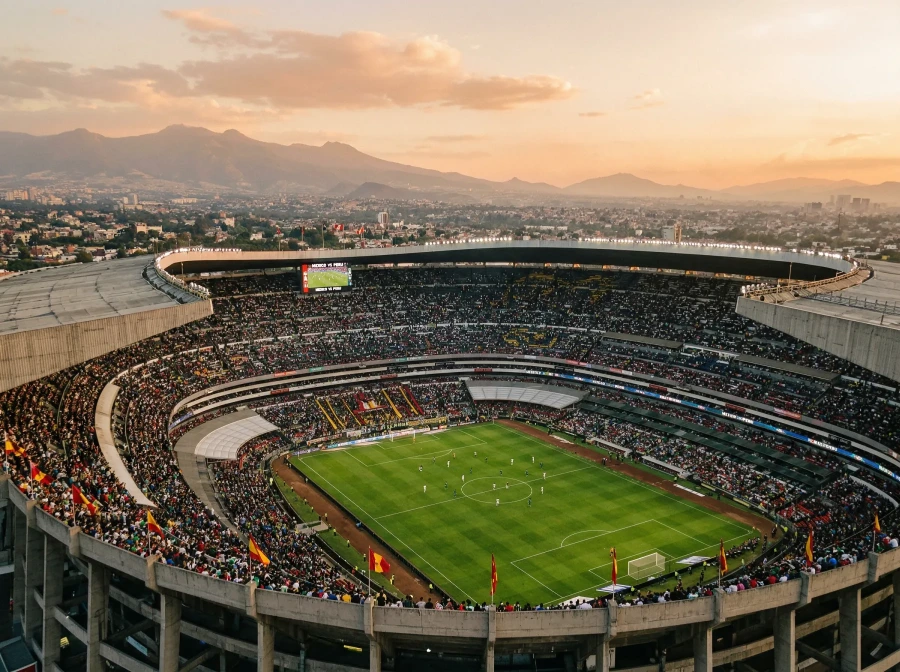
No stadium on Earth has hosted more World Cup history than the Estadio Azteca. Two finals — 1970 and 1986 — both producing iconic moments that define the sport’s collective memory. Pele’s Brazil lifting the Jules Rimet Trophy. Maradona’s Hand of God and the Goal of the Century against England, both in the same match. On June 11, 2026, the Azteca adds another chapter: the opening match of the first 48-team World Cup, Mexico versus South Africa, in a venue that breathes football history from every concrete tier.
About the Estadio Azteca
Built in 1966 and renovated multiple times since, the Estadio Azteca sits in the Coyoacan neighbourhood of Mexico City at an altitude of 2,240 metres above sea level. That altitude is not a footnote — it is the single most important physical variable at any World Cup venue. Visiting teams experience reduced oxygen availability that affects endurance, sprint recovery and decision-making fatigue, particularly in the second half. The Azteca’s capacity has been adjusted downward from its historic peak of 114,000 to approximately 87,000 for modern safety standards, but even at reduced numbers, the atmosphere produced by Mexican fans — the relentless chanting, the coordinated waves, the trumpet sections — creates an environment that overwhelms visiting squads unaccustomed to the sensory intensity.
The stadium’s infrastructure has undergone significant renovation for the 2026 World Cup, including upgraded seating, modernized concourses and improved pitch drainage. The playing surface is natural grass maintained under challenging conditions — Mexico City’s altitude and pollution levels affect turf health in ways that sea-level venues do not experience. Pitch quality at the Azteca has been inconsistent in recent years, with surface degradation during multi-match stretches a recurring concern. For bettors, monitoring pre-tournament pitch reports is essential when pricing matches at this venue. A heavy, uneven pitch at the Azteca favours Mexico’s domestic-league players who train on similar surfaces week after week, while European and South American visitors accustomed to manicured pitches find the first touch and ball speed unpredictable.
2026 Matches at the Azteca
The opening match — Mexico versus South Africa on June 11 at 7:00 PM ET — is the centrepiece of the Azteca’s 2026 allocation. The venue is scheduled for approximately 13 matches across the group stage, making it one of Mexico’s three hosting stadiums alongside the Estadio BBVA in Monterrey and the Estadio Akron in Guadalajara. The concentration of fixtures means the Azteca’s pitch will endure significant wear across two weeks of group-stage action, a factor that influences later matches at the venue.
The 7:00 PM ET kickoff for the opener places the match at 6:00 PM local time in Mexico City — early evening, when the altitude’s effects are compounded by the lingering heat of a June afternoon. Temperatures in Mexico City during June average 23 degrees Celsius, but the combination of altitude, humidity and the stadium’s enclosed bowl creates microclimate conditions that feel significantly warmer at pitch level. Teams accustomed to sea-level European or South American conditions will notice the difference from the warm-up onward.
For Canadian bettors, the 7:00 PM ET start is ideal — a weeknight evening fixture that catches viewers after work and aligns with peak betting hours across Ontario and Quebec. The opening match traditionally attracts enormous global wagering volume, and the host nation’s involvement amplifies that further. Expect the Mexico moneyline to be heavily backed by recreational bettors, potentially pushing the price shorter than the analytical models suggest and creating value on the South Africa draw or moneyline for contrarian positions.
Three World Cups — A Unique Legacy
The 2026 tournament makes the Estadio Azteca the only stadium in history to host matches at three different World Cups. That distinction reflects both the venue’s enduring significance in global football and Mexico’s central role in the sport’s history. The 1970 World Cup final — Brazil 4, Italy 1 — remains one of the greatest matches ever played, with Pele’s Brazil producing a performance so complete that it transcended competition and became art. Sixteen years later, the 1986 World Cup returned to Mexico after Colombia withdrew as hosts, and Maradona delivered a tournament of individual brilliance that culminated in Argentina’s second title.
The historical weight matters for betting context. Host venues with deep World Cup heritage produce atmospheres that are qualitatively different from newer stadiums. The Azteca’s fans understand tournament football at an institutional level — the rhythms of group-stage tension, the emotional arc of knockout matches, the collective eruption that accompanies goals scored in front of 87,000 people who have been waiting for this moment for years. That institutional knowledge produces a crowd that responds to game situations with tactical intelligence — increasing noise when the home team needs momentum, falling silent to allow communication when defensive concentration is required. The home advantage at the Azteca is not just volume. It is calibrated, experienced and devastatingly effective.
Every previous World Cup hosted at the Azteca has seen the home nation advance from the group stage. Mexico in 1970, Mexico in 1986 — both times, the combination of altitude, crowd support and institutional familiarity proved too much for visiting teams to overcome in the group phase. The 2026 edition adds a third data point to that pattern, and the betting market prices Mexico’s group-stage advancement accordingly.
Mexico City and the Altitude Factor
At 2,240 metres, Mexico City’s altitude is the highest of any World Cup host city in 2026. The physiological effects are well-documented: reduced aerobic capacity, faster onset of muscular fatigue, slower recovery between sprints and a measurable increase in dehydration rates. Teams that prepare properly — arriving early, training at altitude, adjusting hydration protocols — can mitigate the worst effects, but full acclimatization requires 10-14 days, a timeline that the compressed World Cup schedule does not allow for most visiting nations.
For bettors, altitude produces specific market patterns. Matches at high-altitude venues historically see fewer goals in the second half compared to the first, as visiting teams’ physical output declines more sharply than acclimatized hosts. The second-half under line is a consistent value proposition at the Azteca, particularly in matches where the visiting team presses aggressively in the first 45 minutes and pays the physical price after the break. Mexico’s tactical approach under recent management explicitly exploits this dynamic — controlled tempo in the first half, increased pressing intensity after 60 minutes when the altitude has sapped the opposition’s legs.
Mexico City itself is a sprawling metropolis of 21 million people, offering a cultural experience unlike any other World Cup host city. The food culture — from street-corner taquerias to high-end restaurants in Roma and Condesa — is among the world’s best. The historical centre, Chapultepec Park and the Frida Kahlo Museum provide non-football diversions, though the matchday experience at the Azteca is an attraction that rivals any cultural landmark. The Coyoacan neighbourhood surrounding the stadium offers a more local atmosphere than the tourist-heavy Zona Rosa, with markets, cantinas and colonial architecture that reward exploration on non-match days. For Canadian fans making the trip, direct flights from Toronto to Mexico City take approximately five hours, with multiple daily departures on major carriers. Montreal and Vancouver also offer direct connections, making Mexico City one of the more accessible international venues for Canadian travellers.
Opening Night at Football’s Cathedral
The Estadio Azteca is not just a venue — it is a monument to football’s emotional power. The 2026 opening match will add another layer to a legacy that spans six decades, and for bettors, the implications are concrete: altitude-adjusted match pricing, home-advantage premiums on Mexico’s fixtures, and the institutional crowd intelligence that makes the Azteca the most formidable home-field environment at the entire tournament. When pricing Mexico’s Group A campaign and the broader outright market, the Azteca factor is not a sentimental consideration — it is a quantifiable edge that shapes realistic probabilities for every match played within those storied walls.
